What is Data Governance? A complete guide

Data governance becomes necessary when an organization has data, but cannot be sure whether it can trust it. Sales shows one number, finance shows another. A Power BI report differs from CRM data. In a manufacturing company, the same material index may have different names in ERP, Excel, and the warehouse system. Data about batches, suppliers, certificates, complaints, or quality control is spread across several places.
No one is sure which version of a product specification is current, who owns component data, or whether the origin of a material can be traced quickly when a customer or auditor asks for it. The company wants to use AI, automation, or better reporting, but first it needs answers to simpler questions: where the data is, what it means, who owns it, and who can use it.
In this article, we explain what data governance is and why an organization needs data governance rules, even if it does not yet have a large data team, its own data warehouse, or advanced AI projects. Read on to learn:
- what data governance is and what it covers,
- how it differs from data management and data security,
- who should be responsible for it in a company,
- how to check your organizations Data Governance maturity to tell whether the current way of working with data limits decision-making, regulatory compliance, or business growth.
Data Governance – definition
Data governance is a set of rules that define roles, processes, standards, and technologies that help a company manage data so that it is trustworthy, secure, understandable, and useful for the business. Data governance goes beyond a single document or tool. It is a way of working with data that connects people, processes, and technology.
IBM describes data governance as a data management discipline focused on data quality, security, and availability, based on policies, standards, and procedures for collecting, owning, storing, processing, and using data.
DAMA, one of the leading organizations in the field of data management, points to accountability, policies, and decision rights related to data as part of data governance.
In practice, data governance answers questions that often have no clear owner in companies, for example:
- Who is responsible for customer data?
- What exactly does “active customer” mean?
- Which sales report is official?
- Who can see personal data?
- Where is the data used in management reports?
- Which data, if any, can be used with an AI model?
- Who approves a change to the definition of margin, revenue, or order status?
Without answers to these questions, a company can work with data to some extent, but it does not have control over it or confidence that the data it uses is trustworthy and secure.
A simple analogy: a library
To make data governance easier to understand, imagine a library.
In a well-organized library, every book has a title, an author, a category, a place on the shelf, and an entry in the catalogue. It is clear which copies are available, which have been borrowed, who can use selected collections, and who is responsible for keeping each section in order. When someone is looking for a specific book, they do not need to walk between shelves and ask several people – they can check the catalogue to see where the book is and whether they can use it.
Now imagine a library without such rules. The same book is listed under several different names. Some people put it back in the wrong place. No one knows which catalogue is current. It is unclear who is responsible for a given section. Some materials are available to everyone, although they should not be. When someone needs specific information, the search turns into guessing and asking others for help.
The same thing happens with data in a company.
Data also needs to be named, described, classified, and assigned to an owner. It is worth defining who can use it, which sources are official, and how to check the history of changes. Data governance organizes these areas. As a result, data is no longer a random collection of information scattered across systems, files, and reports. It becomes an asset that people can use safely, without losing time on constant checks and confirmations.
What does data governance include?
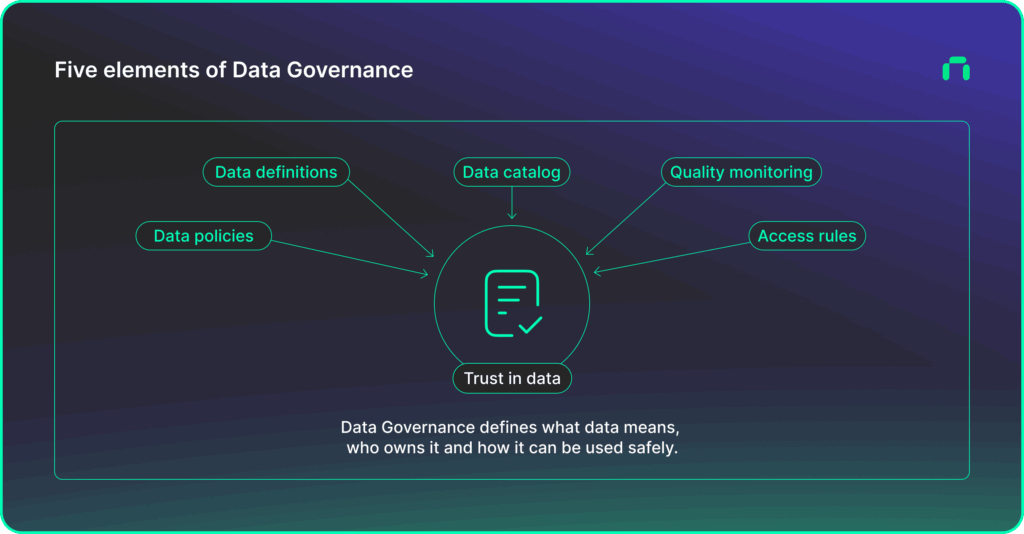
Since data governance is a system based on rules, it consists of several connected elements. The main elements of data governance are:
- data definitions,
- policies,
- data catalogue,
- access control: roles and permissions,
- auditing and monitoring.
Data definitions
Data definitions explain what the most important business terms used in the company mean.
For example, “customer” may mean a person who created an account, a person who bought a product, a company in CRM, or an entity registered in the financial system. Each department may understand the word differently. Until the definition is agreed, reports will differ.
The same applies to terms such as revenue, margin, lead, conversion, active user, return, complaint, supplier, production batch, or finished product.
Data governance helps create a shared business glossary. The goal is clarity and consistency. When a management report shows “revenue”, everyone knows whether it means gross revenue, net revenue, revenue after returns, revenue before discounts, revenue by order date, or revenue by invoice date.
Policies
Policies define how data should be handled.
They may cover, for example, which data is confidential, how long personal data is stored, who can export customer data and how, which data can be used in AI tools, how new tables in a data warehouse should be described, or when a report can be considered official.
A good policy should not be a document no one reads. It should be built around real situations from daily work. Here are a few examples:
“Customer personal data cannot be moved to test environments without anonymization.”
“A new management report must include the data source, owner, and definitions of the metrics used.”
“Margin data may be available only to selected roles [specific roles listed here].”
“Exporting data to external AI tools requires prior data classification.”
Policies provide direction. Processes and tools help people apply these rules.
Data catalogue
A data catalogue is a place where an organization describes its data: sources, tables, reports, owners, definitions, classifications, and links between datasets. It is a table of contents with a detailed instruction manual.
Without a catalogue, employees often search for data through messages, old links, questions to analysts, or file copies. Common questions appear: “Where is the current report?”, “Is this table still used?”, “Who owns CRM data?”, “Is this dashboard official?”.
A data catalogue organizes this knowledge. It helps people check where data is stored, what it means, who owns it, whether it is current, and whether it can be used for a given purpose. Microsoft describes data governance in Purview as an approach that makes data used in operations, reporting, and analytics easier to find, accurate, trusted, and protected.
In a smaller company, a data catalogue may start as a simple list of the most important reports, systems, and owners. In a larger organization, tools for metadata cataloguing, data classification, search, and lineage are usually needed.
Access control: roles and permissions
Not everyone in a company should have access to all data. This is obvious for personal data, financial data, salaries, purchase prices, margins, customer data, and supplier information. In practice, access should always have a clear reason. Employees in specific positions should have access only to the data they need to do their work.
Access control defines who can access different types of data and how. It answers questions such as:
- Who can view the data?
- Who can edit it?
- Who can export it?
- Who can grant access to others?
- Which data should be masked?
- Which data should not leave a specific system?
Data governance helps connect permissions with roles in the company. Access is no longer granted at random. The organization defines rules: sales can see the data needed to support customers, finance can see billing data, marketing can use campaign data, and access to sensitive data is limited and monitored.
This also matters when AI enters the organization. A model, chatbot, or internal assistant should not have access to data that the user of that tool should not be able to see.
Auditing and monitoring
Auditing and monitoring make it possible to check what happens to data over time.
This includes the history of changes, access, exports, processing, quality errors, and data flows between systems. When a problem appears, the company should be able to answer: where the data came from, who changed it, where it went, and which reports may have been affected by the error.
What is data lineage?
In the context of data monitoring, data governance often uses the term data lineage.
Data lineage is information about where data comes from, what path it takes through systems, and where it is used later.
In other words, lineage shows the “travel history” of data.
Example:
Order data is created in an e-commerce system. Then it goes to ERP, next to a data warehouse, where it is calculated according to specific rules, and finally appears in a sales report in Power BI.
Lineage shows this path:
e-commerce system → ERP → data warehouse → sales table → Power BI report
This helps the company answer questions such as:
- where the data in a report comes from,
- which systems it passed through,
- which transformations were applied along the way,
- which reports or models use a given source,
- what will happen if a table, definition, or calculation method changes.
The question “who changed the data?” is more related to audits, logs, and monitoring. Lineage mainly shows data flows and dependencies. Auditing shows who did what with data and when.
Monitoring helps maintain data quality
Through regular data monitoring, an organization can keep data quality at a stable level. Below are a few examples of quality rules used in monitoring:
- no empty customer ID,
- no orders without a date,
- consistent tax identification number format,
- no duplicate suppliers,
- sales totals aligned between ERP and the data warehouse,
- an alert after a sudden drop in the number of transactions from a given source.
Data governance does not make errors disappear forever. It gives the organization a mechanism to detect, explain, and fix them.
Data Governance vs. Data Management and Data Security
Data governance, data management, and data security are closely connected, but they cover different levels of responsibility for data. Before we go further into data governance, it is worth separating these three concepts.
Data management is the broad management of data throughout its entire lifecycle: from acquisition, storage, integration, modelling, quality, architecture, analytics, and security to archiving or deletion. Data governance is one part of this wider area. It defines the rules, responsibilities, and decision rights that bring order to data management.
Data security focuses on protecting data against unauthorized access, leaks, loss, or misuse. It includes encryption, access control, incident monitoring, data loss prevention, and infrastructure security. Data security protects data. Data governance helps define what needs protection, why, from whom, and under which rules. Data governance creates a strong base and practical guidance for data security specialists.
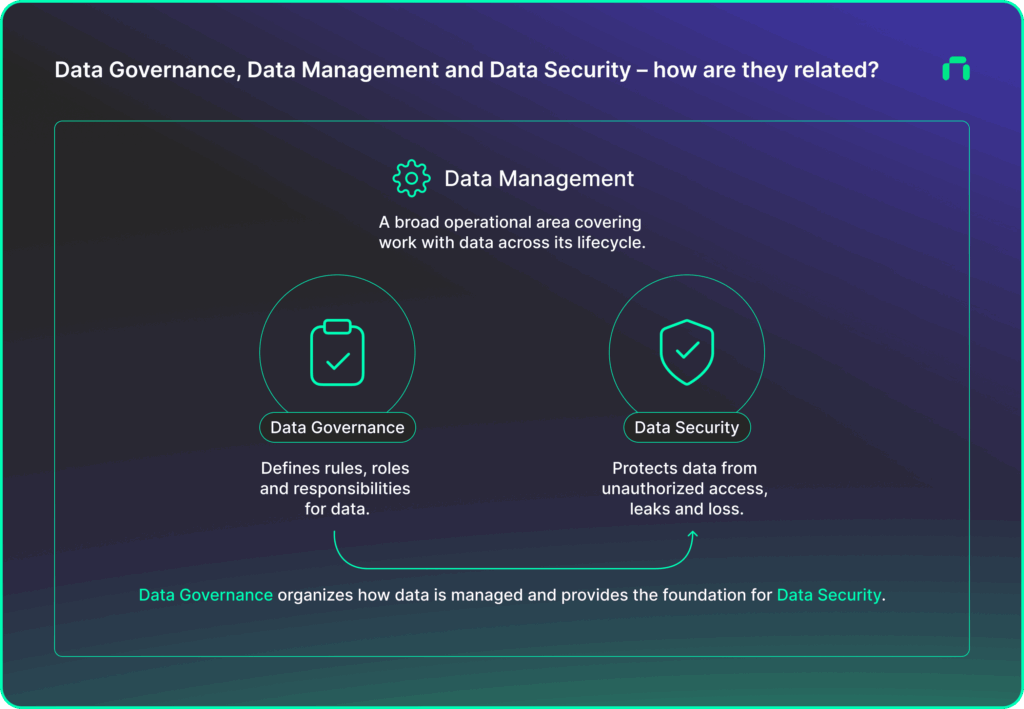
Data governance connects data management and data security at the organizational level. It defines which data is confidential, who owns access decisions, which data requires masking, where personal data is stored, how change approval works, and which source is official.
Who builds data governance in a company?
Data governance should not be handled by IT alone
Technical teams play a major part in tool maintenance, system integration, architecture, and automation, but the meaning of data is created in the business.
If responsibility for data sits only with IT, data governance cannot work at a high level.
Data governance works when data rules are present in daily team routines
It cannot end with a document full of definitions, policies, and procedures that no one opens after implementation. If written rules and procedures are ignored in operational work, the company will not build trust in data or improve data-related processes over time.
Building and maintaining data governance usually involves management and employees from many departments at different levels:
Board or business sponsor – sets direction, defines priorities, and resolves disputes between departments.
Data owner – a person responsible for a specific data area, such as customer data, product data, financial data, supplier data, or production data.
Data steward – a person who takes care of definitions, quality, data descriptions, and daily use of rules in a given area.
IT, BI, and data engineering – teams responsible for systems, data warehouses, reporting, integrations, technical quality, the data catalogue, and automation of rules.
Security, compliance, and legal – people responsible for security, regulatory compliance, privacy, data retention, and audit support.
Business users – people who use data every day in sales, marketing, finance, production, purchasing, customer service, or logistics.
The healthiest model is based on cooperation between business and technology
The business explains what data means and what it is needed for. IT helps organize it technically. Security and compliance teams manage risk controls. The board makes sure decisions do not get stuck in discussions between departments.
Why is data governance important?
Data governance affects whether data helps a company:
- make business decisions,
- acquire new customers and deliver high-quality service to existing ones,
- take care of product and service quality and development,
- improve processes and optimize costs,
- introduce effective automation.
In practice, this applies to most companies. A level of data governance matched to the organization’s maturity can bring benefits that are visible both in everyday work and in business results.
Benefits of data governance
Greater trust in reports
When a company has agreed definitions and official data sources, meetings no longer circle around the question of which number is true. The discussion can move to decisions based on reliable and current data, with less dependence on intuition.
Faster work across teams
Analysts, managers, and specialists spend less time looking for current files, checking definitions, or trying to find the data owner. A data catalogue, business glossary, and source descriptions shorten the path from question to answer.
Lower risk related to personal and confidential data
The organization knows where sensitive data is stored, who has access to it, and where it is shared further. This is especially relevant for GDPR compliance, audits, security incidents, and new tool implementations. The European Commission states that violations of data protection rules may lead to measures such as a ban on data processing and a fine of up to EUR 20 million or 4% of the company’s total worldwide annual turnover. Data governance is the basis for work on data security and regulatory compliance.
Better preparation for AI implementation
AI models, automations, and internal assistants need data that is current, described, correct, and available according to permissions. AI does not fix chaos in data. In many cases, it accelerates the spread of that chaos. If a model uses incorrect margin data, poorly classified personal data, or unofficial reports, the outputs may look convincing but lead to poor decisions.
Safe company scaling
As an organization grows, the number of systems, reports, processes, users, and integrations grows too. Without rules, data starts to take on a life of its own. Data governance helps the company grow without losing control over what it knows about customers, products, suppliers, finances, and operations.
Risks of operating without data governance
Signs of an insufficient level of data governance
A lack of data governance rarely appears as one large problem. More often, it takes the form of small points of friction that become more expensive over time.
Sales shows one number, finance shows another. A Power BI report differs from CRM data. The marketing team uses its own definition of a lead, while the board has yet another version of the result. Personal data is stored in several systems, but no one can quickly point to all the places where it is kept. The company wants to use AI, but cannot be sure whether the data is current, secure, and properly described.
Costs of poor data governance
A lack of data governance rarely causes one visible problem right away. More often, it leads to a chain of delays, errors, and risks that begin to affect decisions, costs, security, and the pace of company growth.
Slower decision-making
When data is inconsistent, scattered, or understood differently by teams, decisions begin with an attempt to determine which number is true. Instead of reacting to market changes, the company loses days or weeks explaining sources, definitions, and differences between reports.
Higher reporting costs
Preparing a reliable report takes more time because analysts and managers need to search for data manually, check whether it is current, and correct errors. The more systems, spreadsheets, and unofficial report versions there are, the more work goes into cleaning up information instead of analysis.
Lower trust in analytics
If the board and teams regularly see different results for the same metrics, they stop treating analytics as a dependable decision support tool. As a result, the organization has data, reports, and dashboards, but still makes many decisions based on gut feeling.
Higher risk of data breaches
Without clear data classification, access rules, and knowledge of where personal or confidential data is stored, the risk of breaches and audit problems increases. IBM’s Cost of a Data Breach 2025 report states that the global average cost of a data breach was USD 4.44 million.
More difficult implementation of new technologies
New systems, BI tools, automations, and AI models work with the data they receive. If they are fed incorrect, outdated, or poorly described data, implementations take longer and require costly fixes because the system does not work and the team needs to find the source of the problem. As a result, an implemented system or tool may create the impression of process improvement while, in reality, it leads to incorrect recommendations or decisions.
Data governance in small and medium-sized companies
Data governance is often associated with large corporations, multi-year programs, and expensive tools. This association often discourages smaller companies.
In reality, a company does not need to start with a large program. In a small or medium-sized organization, a sensible starting point can be very practical. For example, it may be enough to:
- list the most important reports,
- assign data owners,
- describe basic business definitions,
- identify official data sources,
- map personal and confidential data,
- organize access,
- define several quality rules for the most important processes.
In a manufacturing company, the starting point may be product data, material data, suppliers, batches, indexes, complaints, and certificates. In e-commerce, it may be customer, order, product, campaign, and margin data. In a service company, it may be CRM, the sales pipeline, invoices, project profitability, and customer data.
The most important thing is to start with an area that truly affects decisions, risk, or revenue. Data governance does not need to cover the whole organization from day one. When managed well, it can grow in stages.
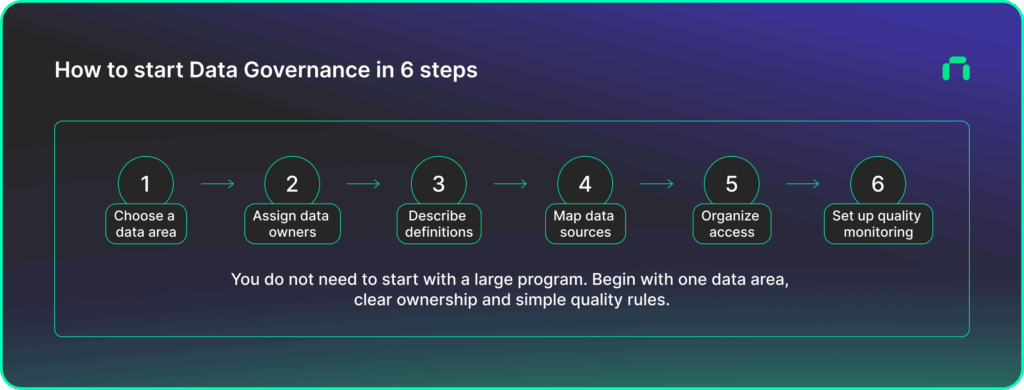
Suggested steps:
- Choose a data area.
- Assign owners.
- Describe definitions.
- Map sources.
- Organize access.
- Set up quality monitoring.
How to assess the level of data governance in an organization
The simplest test is to check whether the company can answer basic questions about its data. For example:
- Is it clear which reports are official?
- Do the most important metrics have one agreed definition?
- Does every important data group have an owner?
- Is it clear where personal and confidential data is stored?
- Is access to data based on roles, or on a history of random requests?
- Can the company trace where data in a management report comes from?
- Is data used in AI, BI, or automation described and checked?
- Is a data audit an organized process, or manual information gathering across many places?
If most answers are “no”, “partly”, or “it depends who you ask”, the organization probably has room to improve its data governance.
You can start with our checklist. It will help you quickly check where the company has gaps and areas for development.
Download free checklist
If you need a fuller diagnosis, contact our team. As part of a dedicated audit, we can analyze your current data management model, identify risks, and propose an action plan tailored to your company.
We’ll check it and help you take care of data governance step by step.
FAQ
How does data governance differ from ordinary data cleanup?
Data cleanup often means a one-time effort: cleaning datasets, correcting reports, or removing duplicates. Data governance creates rules, roles, and processes that help data stay organized over time. It is about responsibility, definitions, access, quality, and control over data use.
Is data governance only for large companies?
No. Smaller companies also need reliable data, especially when they grow, implement BI, automation, AI, or operate in a regulated industry. The scale is different. A small company can start with the most important reports, a few definitions, data owners, and basic access rules.
Does data governance require a dedicated tool?
At the beginning, not always. A tool helps when there are many data sources, the number of users grows, and the company needs automation for the catalogue, classification, lineage, or access control. A tool alone will not solve the problem without agreed rules, owners, and processes.
Who should be responsible for data governance?
The best setup divides responsibility between business, IT, data/BI, security, and compliance. The business should define the meaning of data, IT and data teams should support technical implementation, and security and compliance should manage risks and regulatory requirements. A sponsor on the board side is also needed.
Where should a company start with data governance?
The best starting point is one important data area: sales, finance, customers, products, suppliers, personal data, or management reporting. The first step is to list the most important sources, definitions, owners, reports, and access rights. Then the company can add quality rules, a data catalogue, monitoring, and more formal policies.
You might also like

Web analytics in healthcare: why consider implementing Piwik PRO?
A hospital or clinic website has become more than a digital business card. With the right features, it serves as a fully fledged communication channel [...]

Accessibility checklist: is your website ready for the European Accessibility Act?
Which organizations must comply with the EAA? How can you ensure your digital service meets the EAA standards? Read on to find out.

How a strong technical infrastructure drives growth for e-commerce
Why the technical setup of online stores matters more than most teams realize – and how it directly influences engagement, conversions, and revenue.